2026 Under Submission

How Jailbreak Attacks Inform Safety Alignment: A Defender-Centric, Shapley-Based Evaluation of Jailbreak Contributions

1ShanghaiTech University 2Zhejiang University
Corresponding author
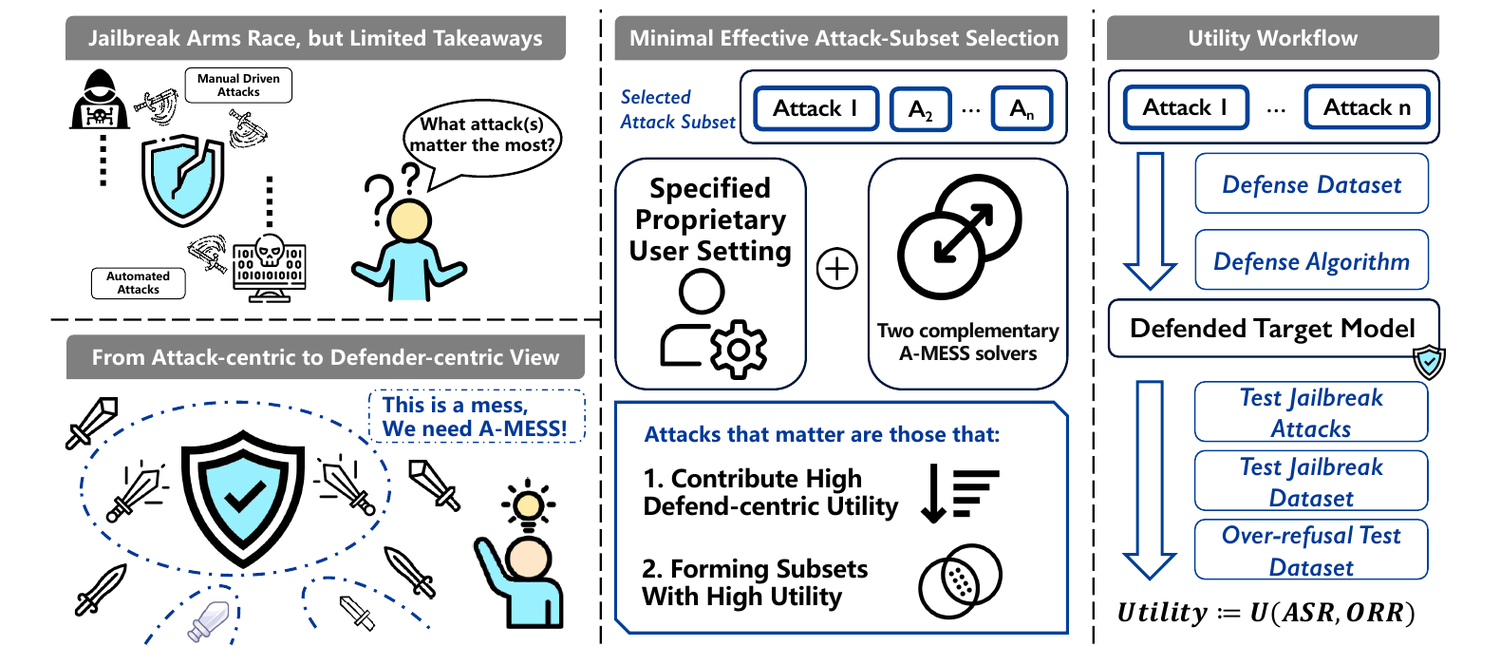
A-MESS defender-centric workflow overview

Abstract

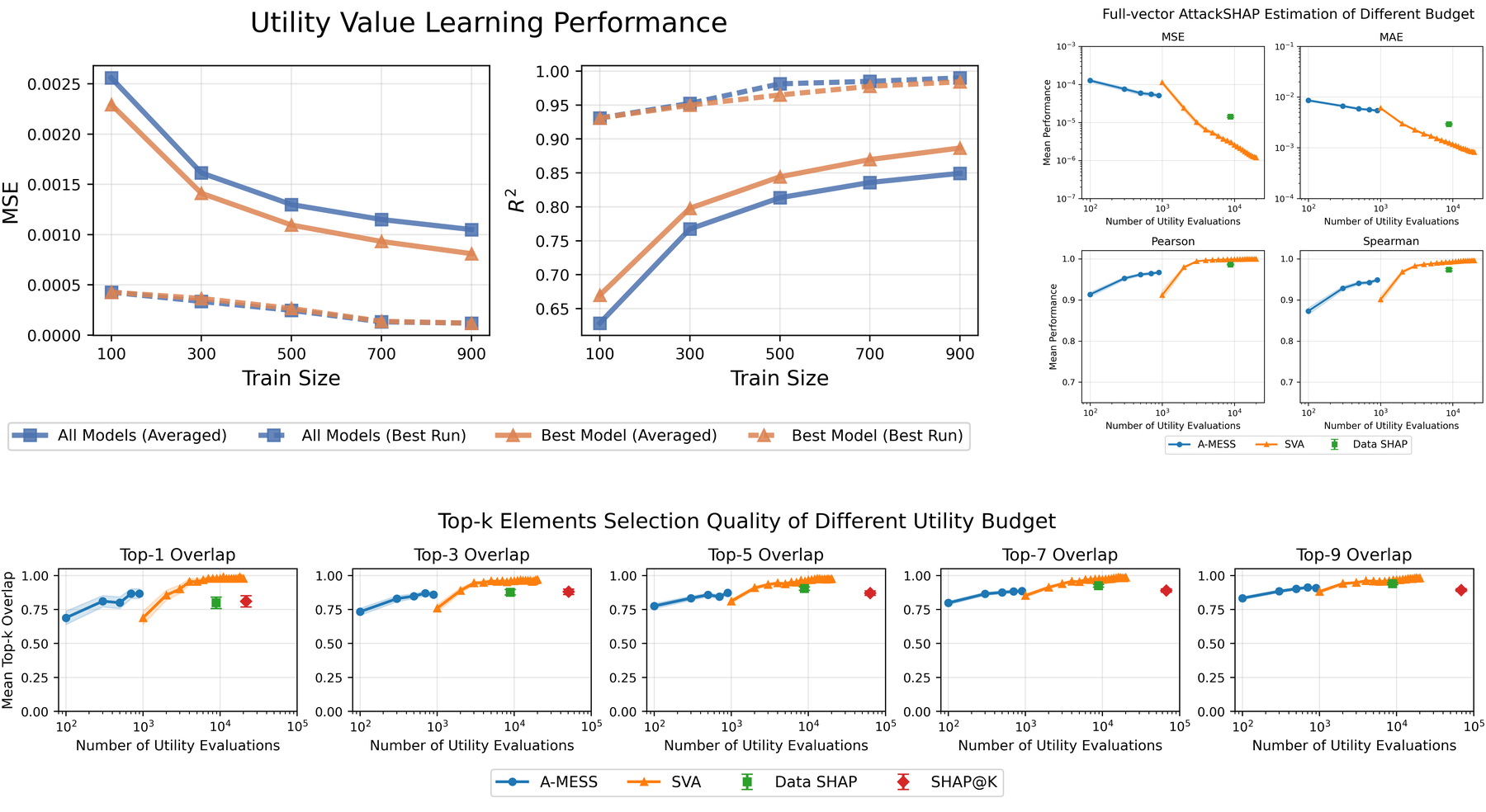
Jailbreak attacks on large language models are usually evaluated by attacker-centric metrics such as attack success rate (ASR), yet an attack that breaks a model is not necessarily useful for improving its safety. We propose a defender-centric view of jailbreak evaluation, where attacks are evaluated by the downstream safety improvements they enable when used as red-teaming data for safety training. Building on this view, we introduce A-MESS (Minimal Effective Attack-Subset Selection), a setting-agnostic framework for attributing and selecting jailbreak attacks from black-box subset utility observations. A-MESS estimates AttackSHAP, a Shapley-based score that attributes marginal utility to individual attacks and selects compact attack subsets under user-specified budgets via greedy or surrogate-based optimization. Across controlled utility landscapes and real LLM safety settings, we find that ASR rankings are weakly aligned with defender-centric utility, that AttackSHAP can be estimated accurately with limited utility queries, and that directly optimizing subsets yields stronger safety utility than attacker-centric or attribution-only selection. These results suggest evaluating jailbreak attacks as resources for improving safety, not only as tools for breaking models.
Method

01

Defender-Centric Utility

A safety setting defines a black-box utility function \(v_\theta(S)\) over attack subsets. The value of a subset is measured after it is used inside a defense workflow and evaluated on held-out jailbreak and over-refusal tests.

02

AttackSHAP Attribution

Attacks are treated as players in a cooperative game. AttackSHAP assigns each attack an average marginal utility contribution across subset contexts, making contribution setting-specific rather than purely attack-centric.

03

Minimal Effective Subsets

A-MESS solves the budgeted subset-selection problem with two complementary solvers: a direct greedy search over true marginal gains, and a surrogate search over a learned utility landscape \(\hat v_\theta\).

AttackSHAP Attribution

\[ \phi_i^\theta = \mathbb{E}_{\pi} \left[ v_\theta(P_i^\pi \cup \{a_i\}) - v_\theta(P_i^\pi) \right] \]

Budgeted Selection

\[ S_k^\star = \arg\max_{S \subseteq \mathcal{A},\, |S|=k} v_\theta(S) \]

Key Results

0.215

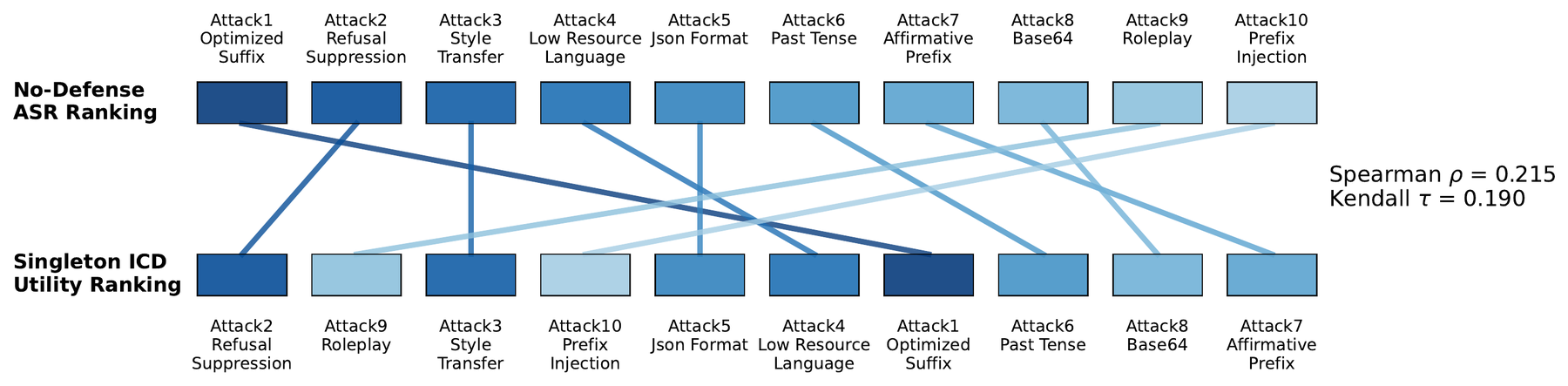
ASR weakly predicts utility

No-defense ASR and singleton ICD utility are weakly correlated in the real setting, with Spearman ρ = 0.215 and Kendall τ = 0.190.

0.828

Surrogate utility learning

On real Qwen2.5-7B adversarial-training utilities, the surrogate reaches R^2 = 0.828 with 150 training subsets.

82.69%+

Recovered oracle gain

On synthetic landscapes, A-MESS-GREEDY recovers at least 82.69% of the oracle improvement gap for nontrivial budgets.

0.9397

Best real subset utility

In the Ministral-3 ICD setting, both A-MESS solvers select {1, 2, 3, 6} for k = 4 and reach utility 0.9397.

Minimal Effective Subset Playground

Budget
Landscape Dataset 0
Best practical method A-MESS-Greedy
Oracle utility 0.0000
Method Selected subset Utility Normalized gain

Figures

Contributions

Reframing. Jailbreak attacks are evaluated as resources for improving safety alignment, not only as tools for breaking an undefended model.

Attribution. AttackSHAP uses Shapley-style marginal contribution to assign setting-specific credit to individual jailbreak attacks.

Selection. A-MESS turns attribution into a practical subset decision by selecting compact attack sets that maximize downstream defense utility.

BibTeX

@misc{zhou2026jailbreakattacksinformsafety,
  title={How Jailbreak Attacks Inform Safety Alignment: A Defender-Centric, Shapley-Based Evaluation of Jailbreak Contributions}, 
  author={Yukai Zhou and Feiyang Lu and Xiaokai Mao and Jinfei Liu and Wenjie Wang},
  year={2026},
  eprint={2607.17152},
  archivePrefix={arXiv},
  primaryClass={cs.CR},
  url={https://arxiv.org/abs/2607.17152}, 
}